

Introduction
If you are going for Umrah from the UAE for the first time, Ihram is probably the part you think about most: what do I wear, when do I put it on, and what am I not allowed to do? This Ihram guide for Umrah answers all of it in simple words.
Ihram is not just the white cloth. It is a sacred state that starts when you make the intention for Umrah at the miqat. Once you are in that state, certain rules apply until your Umrah is complete. The rules are simple, and your group guide will help you.
What Is Ihram?
Ihram has two meanings, and both matter.
First, it is the state of purity and devotion a pilgrim enters before Umrah, by making the intention (niyyah) and reciting the Talbiyah at the miqat, the boundary point on the way to Makkah. From that moment until your Umrah is finished, you follow the rules of Ihram.
Ihram is the sacred state a pilgrim enters before Umrah, by making the intention at the miqat and reciting the Talbiyah. It is not only the white cloth men wear. Once you enter Ihram, specific rules apply until Umrah is complete, including no perfume, no cutting hair or nails, and no stitched clothing for men.
Second, the word Ihram also means the simple white garments men wear. The plain white cloth reminds every pilgrim that before Allah, everyone is equal, rich or poor, young or old. That is the spirit of Ihram: simplicity, humility, and focus on worship.
For women, there is no special Ihram garment. A woman wears her normal modest clothing.
Ihram for Umrah is the first step of the pilgrimage. You enter it at or before the miqat, the boundary on the way to Makkah, by intending Umrah in your heart and reciting the Talbiyah. From that moment you follow Ihram rules until you finish Tawaf, Sa’i, and cut or shave your hair.
Before Ihram: Get Ready in Order
Do these steps in order, before the miqat, so nothing is rushed on the plane or the bus.
- Grooming. Trim your nails, and remove unwanted hair, before you enter Ihram. Do this at home or in your hotel, not after the intention.
- Ritual bath. Perform ghusl, a full ritual bath, before you put on the Ihram garments. If a full bath is not possible, wash and make wudu as your guide advises.
- Perfume on the body before Ihram only. If you use perfume, use it on your body before you enter Ihram, not after. Do not put perfume on the Ihram cloths themselves.
- Put on the garments. Men put on the two white cloths. Women put on their normal modest clothing. Check that nothing scented is on the cloths or clothes.
- Keep your documents ready. Keep your passport, visa papers and Emirates ID in a small pouch you carry yourself.
- Make the intention at the miqat. The intention comes at the boundary point, not before. Wait for the announcement, then intend Umrah in your heart and recite the Talbiyah.
When and Where Do You Enter Ihram?
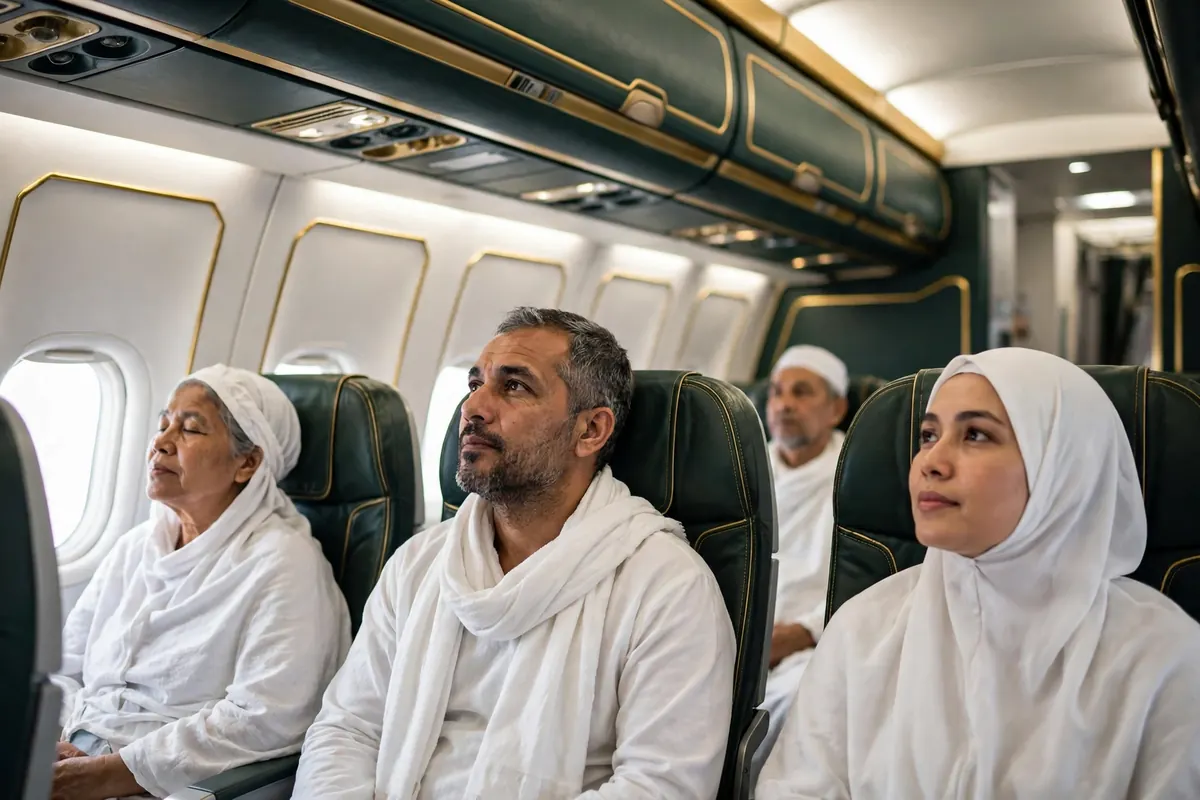
You do not enter Ihram at home in Dubai, and you do not enter it when you land in Jeddah. You enter it at the miqat, the boundary point you cross on your way to Makkah.
You enter Ihram at the miqat, before you cross it on the way to Makkah. For pilgrims flying from the UAE to Jeddah, put the garments on before boarding or during the flight, then make the intention when the crew announces the miqat. Do not wait until you land in Jeddah.
For pilgrims flying from the UAE to Jeddah, the flight passes the miqat in the air. Most UAE pilgrims therefore put on the Ihram garments before boarding, or during the flight, and make the intention when the time comes. The cabin crew usually announces it before the plane reaches the miqat, and your group guide will also tell you. Listen for that announcement and follow your guide. UAE flights to Jeddah cross the miqat in the air, about 20 to 30 minutes before landing, according to the research for this guide.
If you are travelling by bus from Dubai, the journey also passes a miqat point on the road, and your group guide will tell you when to make the intention. The bus stops so the group can make the intention together, so keep your Ihram garments on and your documents ready before the stop.
The intention must be made before you cross the miqat, not after it. If you cross it without entering Ihram, that is a mistake, and your group guide will confirm what you need to do. Stay alert during the flight or the bus journey, keep your Ihram garments on, and wait for the announcement.
The exact miqat name for the UAE to Jeddah flight, and for the bus route, is not stated in this guide. The miqat depends on your flight route, not only on where you live, so your group guide will confirm the exact point for your flight. Do not guess the name from a website. Ask your guide.
Ihram from Dubai: by Air and by Bus
By air: change into Ihram at Dubai airport if that is easier, or on the plane. Many pilgrims change at the airport, because it is easier than changing on the plane. Putting on the garments does not by itself put you in Ihram. The intention comes later, at the miqat. Keep a spare set of Ihram cloths in your hand luggage, so a delayed checked bag does not leave you unprepared.
By bus: put on your Ihram garments early in the journey, and keep them on. The bus journey is long, so wear comfortable sandals, keep water and your documents in your day bag, and listen for your guide. The group stops at the miqat point, and your guide will tell the group when to make the intention together.
Both routes end the same way: intention at the miqat, Talbiyah, then travel to Makkah in Ihram. For the rites that follow, read our How to Perform Umrah Step by Step guide.
The Intention (Niyyah) and the Talbiyah
Entering Ihram has two parts: the intention in your heart, and the words of the Talbiyah on your tongue.
The intention, or niyyah, is simple. In your heart, intend that you are entering Ihram to perform Umrah for the sake of Allah. You can say it in your own words. There is no long formula to memorise. What matters is that the intention is clear before you cross the miqat.
Niyyah is the intention in your heart to perform Umrah for the sake of Allah. You make it at the miqat, before crossing it. You can say it in your own words, and many pilgrims also say, Labbayka Allahumma Umrah, meaning, Here I am, O Allah, for Umrah.
After the intention, recite the Talbiyah:
“Labbayk Allahumma Labbayk, Labbayka la shareeka laka Labbayk, innal hamda wan ni’mata laka wal mulk, la shareeka lak.”
It means: “Here I am, O Allah, here I am. Here I am, You have no partner, here I am. Indeed, all praise and blessings are Yours, and all sovereignty, You have no partner.”
Talbiyah is the prayer recited after the intention for Umrah: Labbayk Allahumma Labbayk, Labbayka la shareeka laka Labbayk, innal hamda wan ni’mata laka wal mulk, la shareeka lak. It means, Here I am, O Allah, here I am. Men recite it loudly, women quietly, and you keep repeating it until Tawaf begins.
Men recite the Talbiyah loudly, women quietly. Keep reciting it often, and when you first see the Kaaba, stop and make your own duas.
If you are unsure of the words, do not worry. Your group guide will recite it with the group, and you can follow along, or keep the words on a small card until you know them by heart.
How Men Wear Ihram
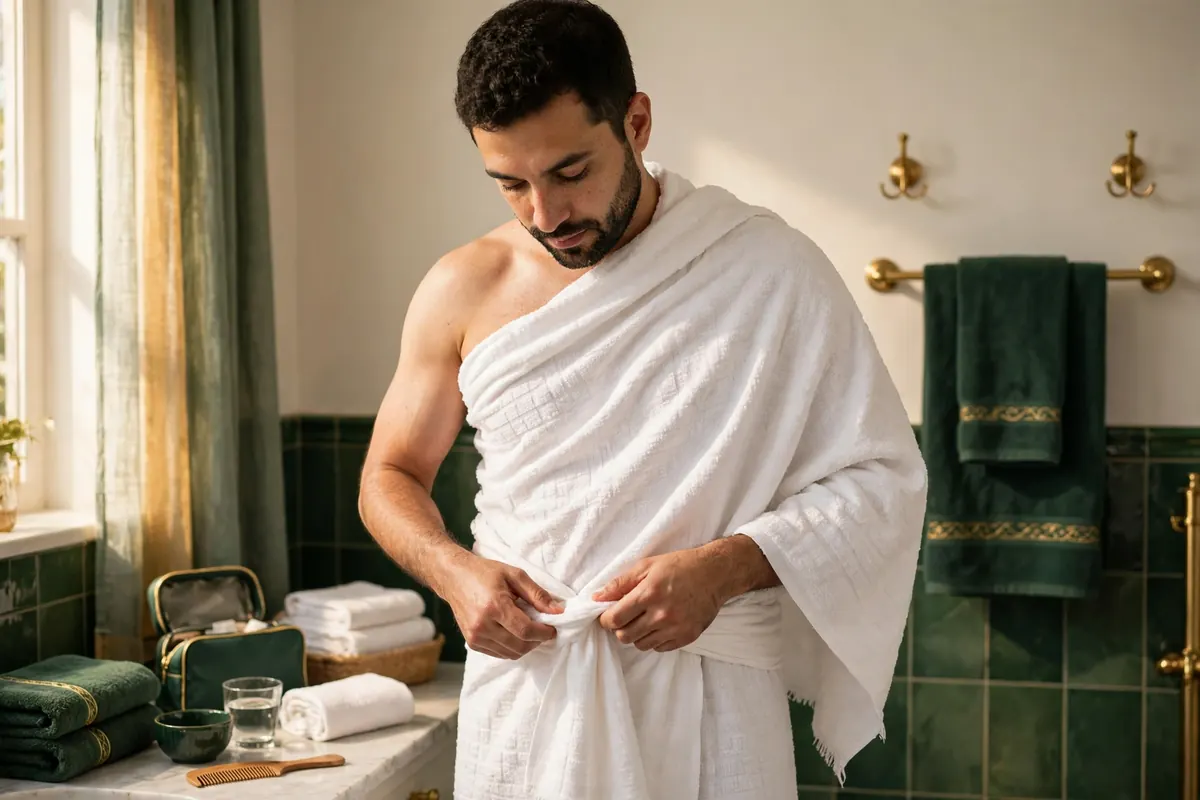
Men wear two pieces of plain white cloth, with nothing stitched underneath.
The two cloths, step by step
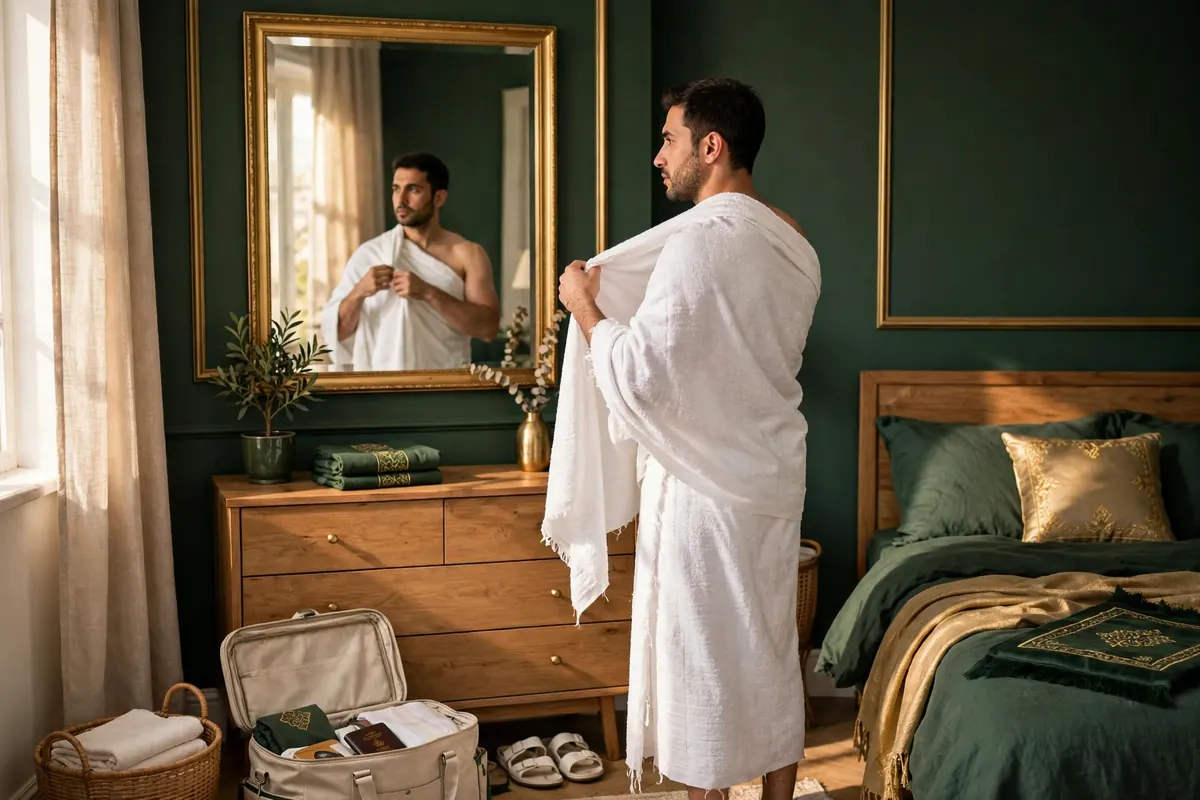
Men wear two plain white unstitched cloths. Wrap the lower cloth, the izar, around your waist from navel to ankle and secure it with a belt. Drape the upper cloth, the rida, over both shoulders. During Tawaf, pass it under your right arm and over your left shoulder, leaving the right shoulder bare.
The lower cloth is called the izar. Wrap it around your waist like a towel, down to your ankles. The upper cloth is called the rida. Drape it over your shoulders, covering your upper body.
That is all: no shirt, trousers, underwear, socks, cap, or hat. The cloths must be plain and white, with no perfume on them. Men must not wear underwear, a vest, shirt, trousers, or socks under the Ihram cloths. The two unstitched white cloths are the full dress.
During Tawaf, the circling of the Kaaba, men follow a practice called idtiba. Pass the upper cloth under your right arm and over your left shoulder, so your right shoulder stays bare. After Tawaf, cover both shoulders again. Your group guide will show you this at the right time.
Practical tips for first-timers
Wear your Ihram at home once or twice before the trip. Walk and sit in it, and practise wrapping the lower cloth so it feels secure. A short practice removes the fear of the cloth slipping.
Use a plain belt or a money belt to hold the lower cloth in place. A few safety pins can also help, but keep them simple and unscented. A plain belt or money pouch is allowed in Ihram because it is not stitched clothing. It holds the lower cloth securely and keeps your passport, cash, and phone safe. Choose a simple unscented belt, and do not use it to carry perfume or scented items while you are in Ihram.
Choose open sandals that are comfortable and already broken in. You will walk a lot, so do not wear new sandals for the first time on the trip. Choose thick cloth that is not see-through, so you feel comfortable in crowds and in prayer.
Pack a spare set of Ihram cloths in your hand luggage. If the first set gets dirty or wet, you can change into the clean set, which must also be plain, white, and free of perfume.
Wash your Ihram cloths with unscented detergent before the trip. Normal washing powder has a smell, and scented products are not allowed in Ihram. Wash them early, let them dry fully, and keep them in a clean bag.
What Women Wear in Ihram

Women do not wear the two white cloths. A woman wears her normal modest clothing in Ihram, usually a loose abaya and a hijab, as she would wear for prayer.
Women do not wear the two white cloths. A woman wears her normal loose, modest clothing in Ihram, usually an abaya and hijab, in any colour. Her face and hands stay uncovered, so she does not wear a niqab or gloves. She must also avoid perfume and scented cosmetics while in Ihram.
In Ihram, a woman should not cover her face with a sewn face veil (niqab), and she should not wear gloves. Apart from that, her normal modest dress stays the same. A woman in Ihram must not wear a fitted niqab or gloves, so her face and hands stay uncovered. She still wears her hijab to cover her hair. If non-mahram men are close, she may lower a loose cloth over her face, but she must not wear a stitched face veil.
Do not wear perfume, scented creams, or scented makeup while in Ihram. Keep your toiletries unscented for the whole time you are in Ihram, just as the men do. Women must not wear perfume or scented makeup, creams, or lotions in Ihram, just as men must not. Keep your skin and hair free of scented products until Umrah is complete. Use unscented soap and moisturiser instead, and save perfume and scented cosmetics for after you exit Ihram.
Wear comfortable, flat shoes. You will walk long distances and climb stairs in the Haram, so comfort matters more than looks. Socks and comfortable walking shoes are fine for women in Ihram.
Women and Menstruation: What to Do

A menstruating woman can enter Ihram at the miqat, perform ghusl, make the intention, and recite the Talbiyah. Menstruation does not stop Ihram. She waits until she is pure and has performed ghusl before Tawaf, because Tawaf requires purity, then she completes Tawaf and Sa’i.
Tell your group guide early if this applies to you, so the group plan can adjust. While you wait, you can still pray, make dua, read, and visit the Haram area for worship that does not need Tawaf. Do not hide it and worry in silence. Your guide has seen this many times, and will help you plan the days around it. For a personal case, ask a scholar, because the details can differ by circumstance.
What Is Not Allowed While in Ihram?
Once you have entered Ihram, the following things are not allowed until your Umrah is complete and you have come out of Ihram:
- Perfume and scented products. No perfume, scented soap, scented shampoo, deodorant, scented tissues, or scented wet wipes. Use plain water and unscented products only.
- Cutting hair or nails. Do not cut, trim, or pull out any hair, and do not cut your nails while in Ihram.
- Covering the head (for men). Men must not wear a cap, hat, or any cloth on the head while in Ihram.
- Stitched clothing (for men). Men must not wear shirts, trousers, underwear, or socks while in Ihram. Only the two unstitched cloths are allowed.
- Hunting. Do not hunt any land animal while in Ihram.
- Marital relations. Husband and wife must avoid intimacy while in Ihram.
While in Ihram, do not use perfume or scented soap, shampoo, deodorant, or wipes. Do not cut hair or nails, and do not hunt. Men must not wear stitched clothing or cover the head. Women must not wear a niqab or gloves. Marital relations and marriage contracts are also not allowed.
These rules apply from the moment you make the intention until you finish Umrah. They are not hard to follow, but the rule about scented products needs attention, because so many everyday items have a smell. Check your bag before you travel and replace scented items with unscented versions.
What Is Allowed in Ihram?
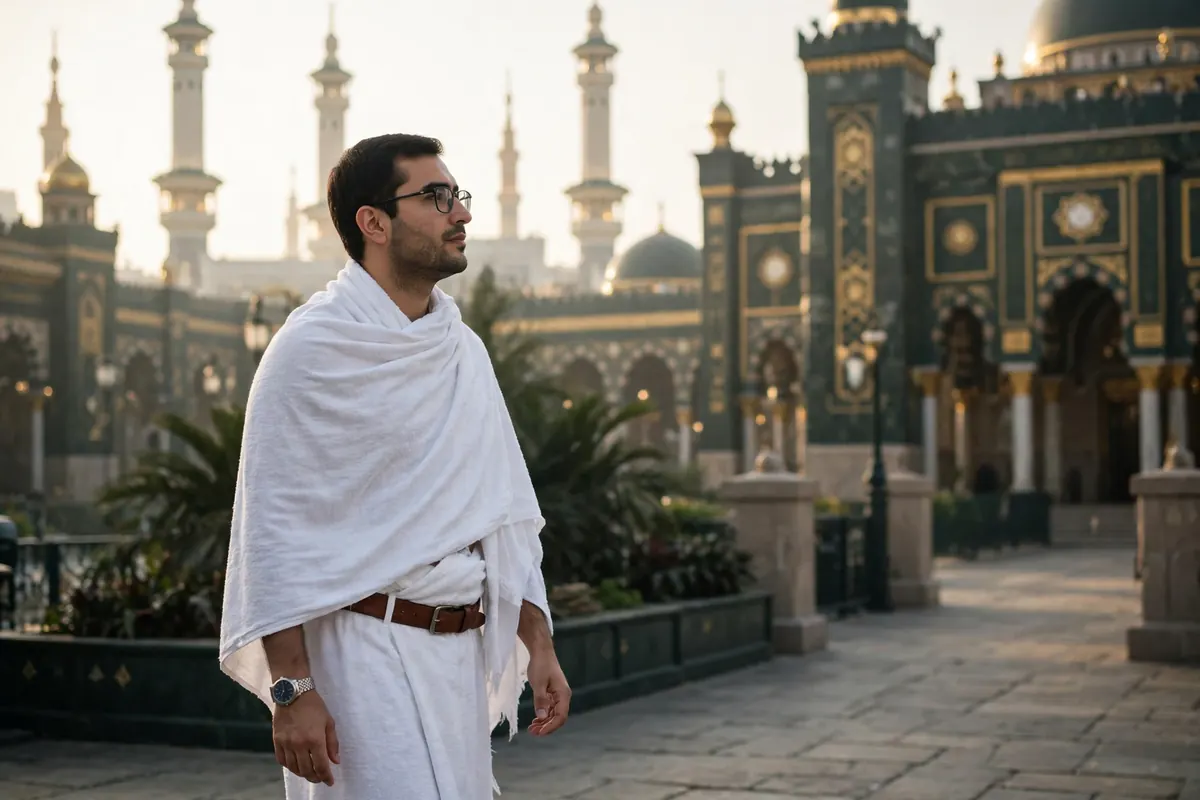
First-timers worry about what they cannot do, and forget what they can still do. This short list answers that worry.
- Unscented soap, shampoo, deodorant and wipes, for washing and freshness.
- Showering or bathing with plain water, and changing into a clean set of Ihram cloths.
- Taking your regular medicines as your doctor advised, and keeping them in hand luggage.
- A watch, glasses, sunglasses, a belt or money pouch, and an umbrella for shade.
- Looking in a mirror, and scratching your head gently, without pulling out hair.
- Eating halal food and drinking water, including meat and seafood.
- Wearing open sandals, and for women, socks and comfortable shoes.
If you are unsure whether something is allowed, ask your group guide before you do it. Do not guess, and do not assume a rule from what another pilgrim is doing.
Unscented Bag Check: Before You Leave Dubai
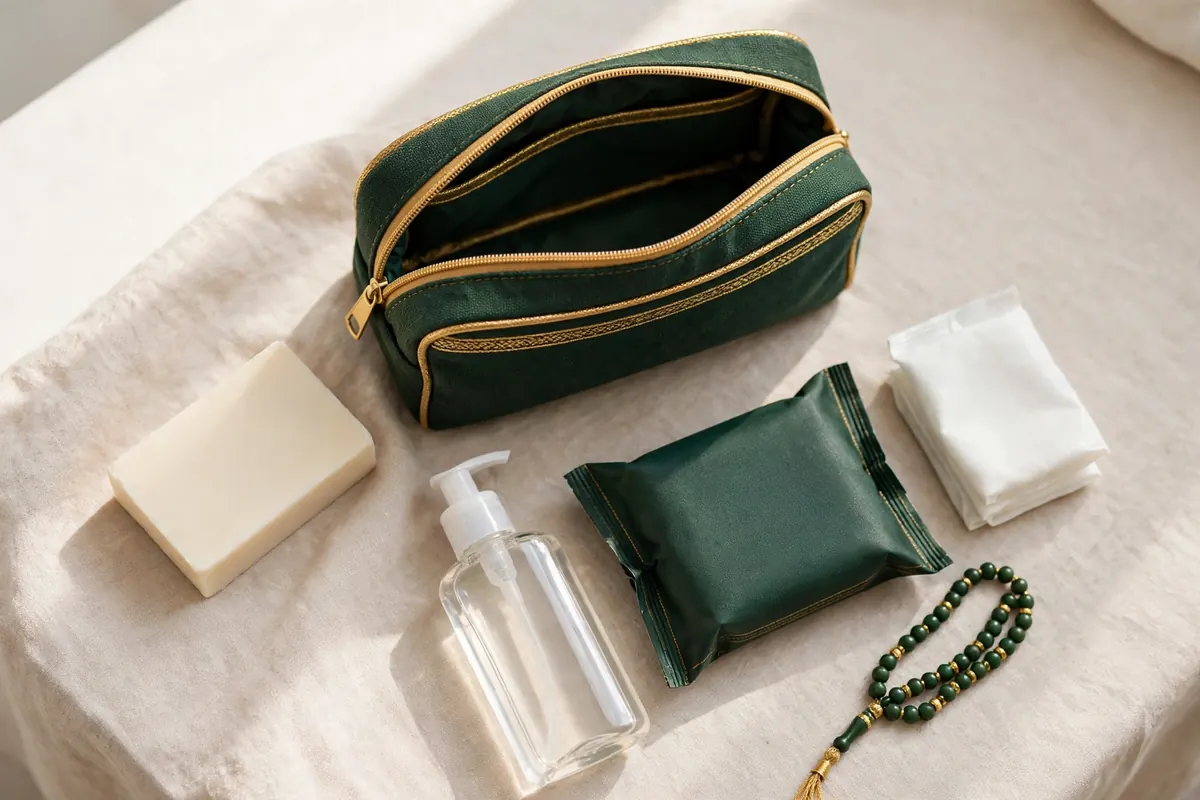
Turn the scented products rule into a bag check, and do it the night before you travel.
- [ ] Unscented soap
- [ ] Unscented shampoo
- [ ] Unscented deodorant
- [ ] Unscented wet wipes and tissues
- [ ] Unscented lip balm
- [ ] Unscented sunscreen
- [ ] Unscented detergent, for washing the Ihram cloths
- [ ] No perfume, no scented creams, no scented makeup in the bag
Perfume and scented products are not allowed once you enter Ihram, on your body, clothes, or in food and drink. That includes scented soap, shampoo, deodorant, tissues, and wet wipes. Use unscented products only, and wash your Ihram cloths with unscented detergent before the trip.
For the full packing list, read our Umrah Packing List from Dubai.
What If You Break a Rule by Mistake?
Do not panic. Mistakes happen, especially on a first Umrah. What matters is what you do next.
If you realise you have broken a rule, tell your group guide as soon as possible. Do not hide it or keep worrying in silence. Your guide has seen this many times and will tell you what to do.
In some cases, breaking a rule by mistake may need a penalty, called a dam. The exact penalty depends on what happened, so your group guide will confirm this for your situation. This guide does not state any penalty amount or any penalty rule, because those details were not supplied or confirmed in the research for this guide. Do not guess a penalty yourself, and do not copy one from a website. Ask your guide or a qualified scholar, because rulings can differ by school and by circumstance.
A mistake does not ruin your Umrah. Tell your guide, follow the advice, and carry on with your worship.
What to do, step by step
- Stop. Do not repeat the act.
- Tell your group guide at once. Say what happened and when it happened.
- Note it down. A short note helps the guide give the right advice.
- Follow the advice you are given. Do not assume your Umrah is invalid, and do not guess a penalty yourself.
- Carry on with your worship. Do not let one mistake take over the whole trip.
If you cross the miqat without entering Ihram, tell your group guide as soon as you realise it. Do not panic and do not guess the remedy yourself. Your guide will confirm what to do for your situation, which may include returning to the miqat or a penalty, so ask before you act.
Children in Ihram
Families travelling with children should plan for this before the trip.
A young child can enter Ihram, and the guardian makes the intention for the child. Keep the rules simple for a child: the same plain dress, no perfume, no cutting hair or nails, and no stitched clothing for boys. Keep a child close to the group, keep water and snacks ready, and keep the child’s documents in the same pouch as yours.
If a child breaks a rule by mistake, tell your group guide at once, just as an adult would. Do not assume a penalty applies, and do not guess one. Ask your guide, because the details can differ by the child’s age and by circumstance.
For what to pack for children and elderly family members, read our Umrah Packing List from Dubai.
Common Mistakes and How to Avoid Them
Knowing these in advance is the best way to avoid them.
1. Entering Ihram too late. Some pilgrims wait until they land in Jeddah, or until the bus is nearly in Makkah, by which time they have already crossed the miqat. Put your Ihram garments on before the flight or early in the bus journey, and listen for the announcement.
2. Wearing stitched clothes underneath. Men sometimes wear underwear or a vest under the Ihram cloths out of habit. This is not allowed. The two cloths are the full dress, so practise at home until you feel comfortable.
3. Using scented products without thinking. Scented soap, deodorant, and wet wipes all break the rule. Switch to unscented products for the whole journey, from the day you leave Dubai.
4. Forgetting the intention. Some pilgrims put on the garments but forget the intention at the miqat. The garments alone do not put you in Ihram. Make the intention in your heart and recite the Talbiyah when the announcement comes.
5. Cutting nails or hair by habit. Biting a nail or pulling out a loose hair counts. Be careful with your hands in Ihram, and keep nail clippers packed away until after Umrah.
6. Perfume on the Ihram cloths. Do not spray perfume on the cloths, and do not wash them with scented detergent. The cloths must be free of any smell.
7. Thinking Ihram ends after Tawaf. Ihram does not end after Tawaf alone. You must also complete Sa’i and cut or shave your hair. Only then can you change into normal clothes.
8. Wearing Ihram early and forgetting the rules have started. If you put on the garments early at the airport, remember that the rules start at the intention, not at the garments. But once you make the intention, the rules apply for the whole journey, so do not use scented products or cut your hair after that point.
When Does Ihram End?
Ihram ends after you complete Tawaf, Sa’i, and cut or shave your hair. Men shave the head or cut it short, and women cut a small length, about a fingertip, from the ends of their hair. After that, you can change into normal clothes and use perfume again.
Ihram ends after you complete the rites of Umrah. The order is simple.
First, perform Tawaf, circling the Kaaba seven times. Then pray two rakats and drink Zam Zam water. Next, perform Sa’i, walking seven times between Safa and Marwah. After Sa’i, the final step is the hair.
Men should shave the head or cut the hair short. Shaving is better, but cutting it short is also accepted. Women should cut a small length from the ends of their hair, about the length of a fingertip. After the hair is cut, Ihram ends. You can then change into your normal clothes, use perfume again, and return to your normal routine.
Your group guide will walk with you through each step. If you are unsure, ask the guide before you act.
First-Timer Tips for Pilgrims from the UAE
A little planning before you leave Dubai makes the whole journey easier.
Pack unscented everything. Soap, shampoo, deodorant, wet wipes, lip balm. If it has a smell, save it for after Umrah.
Pack a spare set. Keep one spare set of Ihram cloths and sandals in your hand luggage, not in the big bag, so a delayed bag does not leave you unprepared.
Keep your documents close. Keep your passport, visa papers, and Emirates ID in a small pouch you carry yourself. For the visa side of your trip, your passport should be valid for at least 6 months, your UAE residence visa or Emirates ID should be valid for at least 3 months, and you need a meningitis vaccination certificate. An Umrah visa is valid for 30 days from the date of issue under the 2026 rule. Read the full visa information before you travel.
Book early. Umrah bookings close 10 days before departure, and a 50% down payment secures your place. Do not leave booking to the last week.
Choose the right package. The Umrah package by bus from Dubai starts from AED 1,200 per person on quad sharing, with 6 days in Makkah and 2 days in Madinah, and it includes a free Ihram. The Umrah package by air from Dubai starts from AED 2,700 per person on quad sharing in economy, with 3 nights in Makkah and 2 nights in Madinah, a direct flight, and departure every Tuesday. Both include visa support, an experienced guide, a Haramain train journey, and a visit to the holy places. Compare all the options on the Umrah packages page, or read the cheap Umrah packages guide if budget matters most. For the best season to travel, read our Best Time to Perform Umrah from Dubai guide, and for the holy sites in both cities, read our Makkah and Madinah Ziyarat Guide.
Stay hydrated and rest. Drink water often and rest between prayers. Your Umrah is not a race.
Frequently Asked Questions
1. What is Ihram?
Ihram is the sacred state a pilgrim enters before Umrah, by making the intention at the miqat and reciting the Talbiyah. It is not only the white cloth men wear. Once you enter Ihram, specific rules apply until Umrah is complete, including no perfume, no cutting hair or nails, and no stitched clothing for men.
2. How to wear Ihram for men step by step?
Men wear two plain white unstitched cloths. Wrap the lower cloth, the izar, around your waist from navel to ankle and secure it with a belt. Drape the upper cloth, the rida, over both shoulders. During Tawaf, pass it under your right arm and over your left shoulder, leaving the right shoulder bare.
3. What do women wear in Ihram?
Women do not wear the two white cloths. A woman wears her normal loose, modest clothing in Ihram, usually an abaya and hijab, in any colour. Her face and hands stay uncovered, so she does not wear a niqab or gloves. She must also avoid perfume and scented cosmetics while in Ihram.
4. When do you enter Ihram?
You enter Ihram at the miqat, before you cross it on the way to Makkah. For pilgrims flying from the UAE to Jeddah, put the garments on before boarding or during the flight, then make the intention when the crew announces the miqat. Do not wait until you land in Jeddah.
5. Can I wear Ihram at Dubai airport?
Yes. Many pilgrims change into Ihram at Dubai airport because it is easier than changing on the plane. Putting on the garments does not by itself put you in Ihram. You enter the state later, at the miqat, when you make the intention and recite the Talbiyah.
6. What is Talbiyah and when do you recite it?
Talbiyah is the prayer recited after the intention for Umrah: Labbayk Allahumma Labbayk, Labbayka la shareeka laka Labbayk, innal hamda wan ni’mata laka wal mulk, la shareeka lak. It means, Here I am, O Allah, here I am. Men recite it loudly, women quietly, and you keep repeating it until Tawaf begins.
7. What is not allowed in Ihram?
While in Ihram, do not use perfume or scented soap, shampoo, deodorant, or wipes. Do not cut hair or nails, and do not hunt. Men must not wear stitched clothing or cover the head. Women must not wear a niqab or gloves. Marital relations and marriage contracts are also not allowed.
8. Can men wear a belt or money pouch in Ihram?
Yes. A plain belt or money pouch is allowed in Ihram because it is not stitched clothing. It holds the lower cloth securely and keeps your passport, cash, and phone safe. Choose a simple unscented belt, and do not use it to carry perfume or scented items while you are in Ihram.
9. Can I shower or bathe in Ihram?
Yes. You can shower or bathe in Ihram with plain water and unscented soap if needed. Bathing does not end Ihram. Avoid scented soap, shampoo, and perfumed creams, and wash gently so you do not pull out hair. You can also change into a clean set of Ihram cloths.
10. Can women wear niqab or gloves in Ihram?
No. A woman in Ihram must not wear a fitted niqab or gloves, so her face and hands stay uncovered. She still wears her hijab to cover her hair. If non-mahram men are close, she may lower a loose cloth over her face, but she must not wear a stitched face veil.
11. Can a menstruating woman enter Ihram?
Yes. A menstruating woman can enter Ihram at the miqat, perform ghusl, make the intention, and recite the Talbiyah. Menstruation does not stop Ihram. She waits until she is pure and has performed ghusl before Tawaf, because Tawaf requires purity, then she completes Tawaf and Sa’i.
12. When does Ihram end?
Ihram ends after you complete Tawaf, Sa’i, and cut or shave your hair. Men shave the head or cut it short, and women cut a small length, about a fingertip, from the ends of their hair. After that, you can change into normal clothes and use perfume again.
Plan Your Umrah with UAE Umrah
If this guide helped you, the next step is simple. UAE Umrah offers Umrah by bus from AED 1,200 and by air from AED 2,700, both with visa support, an experienced guide, and a visit to the holy places.
Message us on WhatsApp at +971 56 704 4355 or view all packages. UAE Umrah and Travels, Al Hana Center, Office 16, 2nd Floor, Al Mankhool Rd, Al Jafiliya, Dubai. Email: info@uaeumrah.com.
For your visa, check the Saudi eVisa portal and our visa information page. For your Umrah and Rawdah permits, book through Nusuk before you travel.
Follow UAE Umrah & Travels: Facebook | LinkedIn | Google Maps | Trustpilot






One Response